Spotlight on Gulf St Vincent Migratory Wader Survey Team
Emma Hawthorne
Spotlight on Gulf St Vincent Migratory Wader Survey Team
Emma Hawthorne
Celebrating the work and resilience of the Gulf St Vincent Migratory Wader Survey Team
Whilst birding is often a beautiful, relaxing activity to engage in, it’s not always a walk in the park. Bird surveying can sometimes mean crawling through muddy mangroves, getting tangled in wait-a-while vine in the rainforest, or even witnessing the impacts of a catastrophic environmental event as the Gulf St Vincent Migratory Wader Survey team have recently experienced.
The Gulf St Vincent Migratory Wader Survey Team are a dedicated group made up of 38 volunteers (some of whom have 30-40 years of experience). Each month the team travel many kilometres to get to “their Site” over the Migratory Wader Season of October through to April. The Survey Team pride themselves in Migratory Wader identification skills to ensure accurate identification and counting of birds. They also welcome newcomers who are prepared to undertake training, work with experienced birders within the group, and who can commit to a given Site.
Site familiarity is important in recognising changes in habitat or threats to birds. This has been particularly important this wader-season because of the South Australian algal bloom. Members have been anxious to see if their “Site” can sustain the usual number of waders that visit there. The team anticipates that the number of Migratory Waders over winter leaving for their breeding grounds may decrease due to the decline of marine food sources.
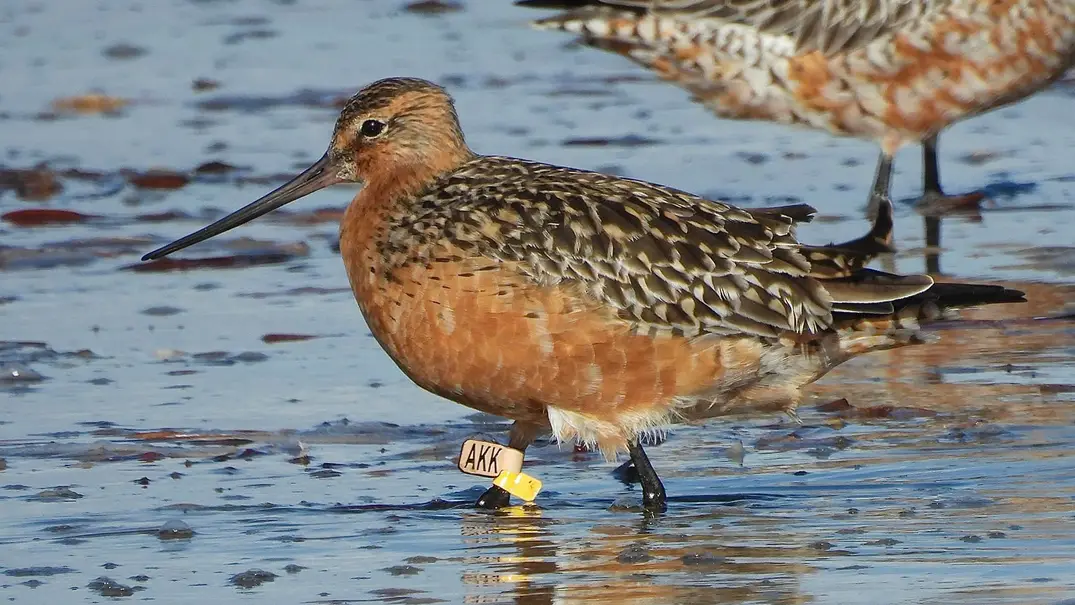
Image: Breeding male Bar-tailed Godwit, a Near-Threatened species (IUCN), frequent to Gulf St Vincent. This individual, identified as ‘AKK’, has been banded as part of the East Asian-Australasian Flyway banding program. Paul Taylor, the photographer, has a special relationship with AKK, sighting the bird for over 10 years and noting its arrival and departure date to Bald Hills each year. Unfortunately, the 2025/26 season was the first year Paul has not seen AKK.
Already, the team’s ongoing monitoring efforts have already contributed to critical projects including the Migratory Shorebird Directory and importantly now may provide valuable evidence of the devastating impacts of this ecological crisis.
The algal bloom is not only visually distressing but has physical and emotional impacts on volunteers. The team have experienced stinging skin and asthmatic symptoms even from surveying through scopes further back from the beach! Kate Buckley, the team’s coordinator describes the multitude of dead marine life as “heart-breaking especially knowing that the sea-bed of Gulf St Vincent will be a “desert” for several years ahead”. Kate says, “it would give us all hope, if the relevant Government bodies would close some of the beaches to the public to give the environment the opportunity to recuperate when and if the algal bloom dissipates”.
“It would give us all hope, if the relevant Government bodies would close some of the beaches to the public to give the environment the opportunity to recuperate when and if the algal bloom dissipates.”
~ Kate Buckley ~
Birdata and the Migratory Shorebirds team are incredibly grateful to the Gulf St Vincent team for all the work they do and their resilience to continue when birds need them most.
If you or a group you are involved in use Birdata for your bird monitoring projects and would like to be featured, please reach out to the Birdata team at birdata@birdlife.org.au.